Executive summary
Every layer of the AI economy runs through Germany
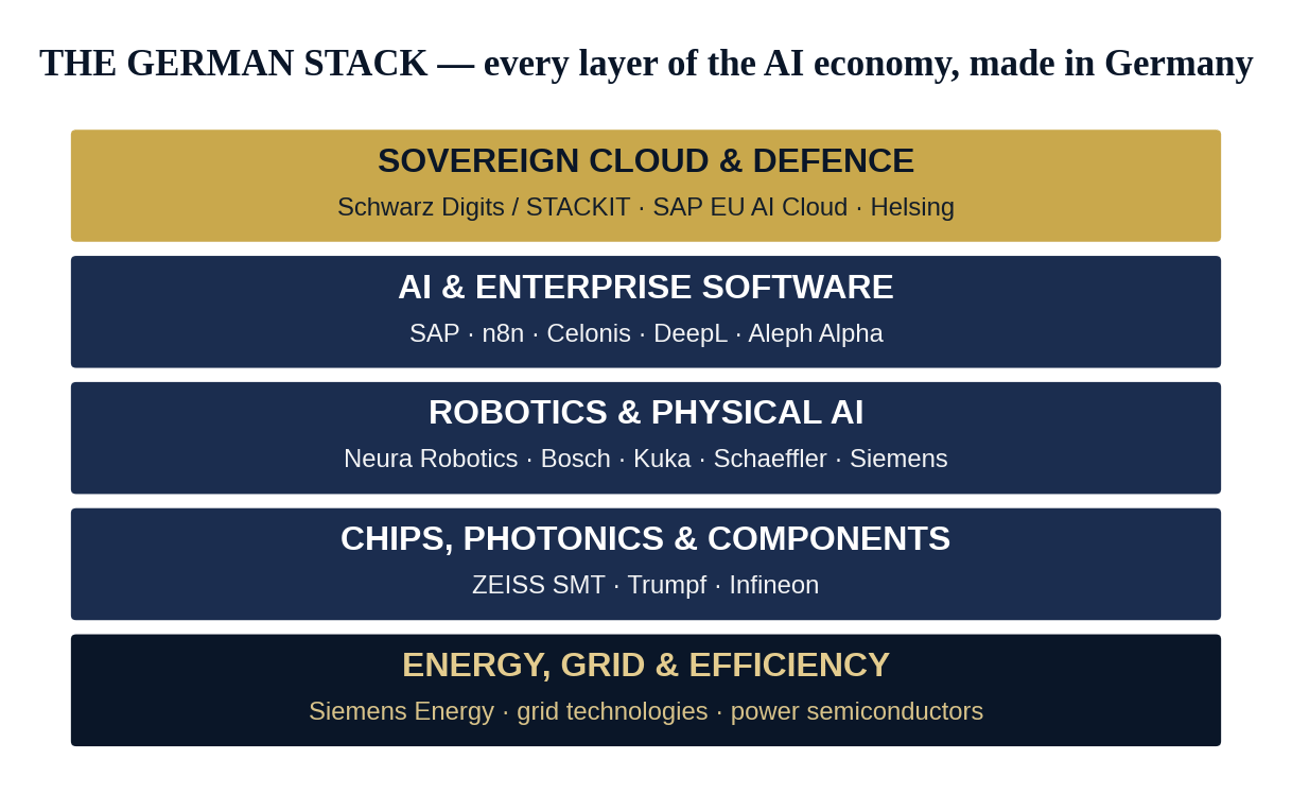
The market narrative says artificial intelligence is an American story with a Chinese challenger. The supply chain says otherwise. The lithography optics behind more than 80% of the world's chips, the lasers that generate EUV light for every advanced Nvidia and Apple processor, the leading automotive and power semiconductors, the densest robot economy in the West, the grid equipment US hyperscalers queue for, Europe's most valuable defence-AI company and its emerging sovereign hyperscaler — all of it is German.
In the spring of 2026, three forces converged. First, Physical AI: the race to embody intelligence in robots and machines shifted the binding constraint from compute to real-world industrial data — Germany's deepest asset. Second, the energy wall: AI's bottleneck moved from chips to electricity, turning German grid and power-efficiency engineering into strategic infrastructure. Third, the sovereignty turn: European data residency, NIS2 and sovereign procurement converted regulation from a tax on innovation into protected demand for European cloud and AI providers. This report maps the full German stack — and how investors and family offices can position before the re-rating completes.
The backdrop favours patient capital. Europe dominates global prosperity rankings — claiming 30 of the top 40 places in the Atlantic Council's 2026 Prosperity Index, with Germany in the elite tier of the 2026 Global Human Prosperity Index — combining institutional stability, rule of law and quality of life with the industrial depth detailed below. For investors weighing capital preservation alongside growth, that pairing of resilience and frontier technology is rare.
Section 1
Chips & photonics: the toll booths of the AI age
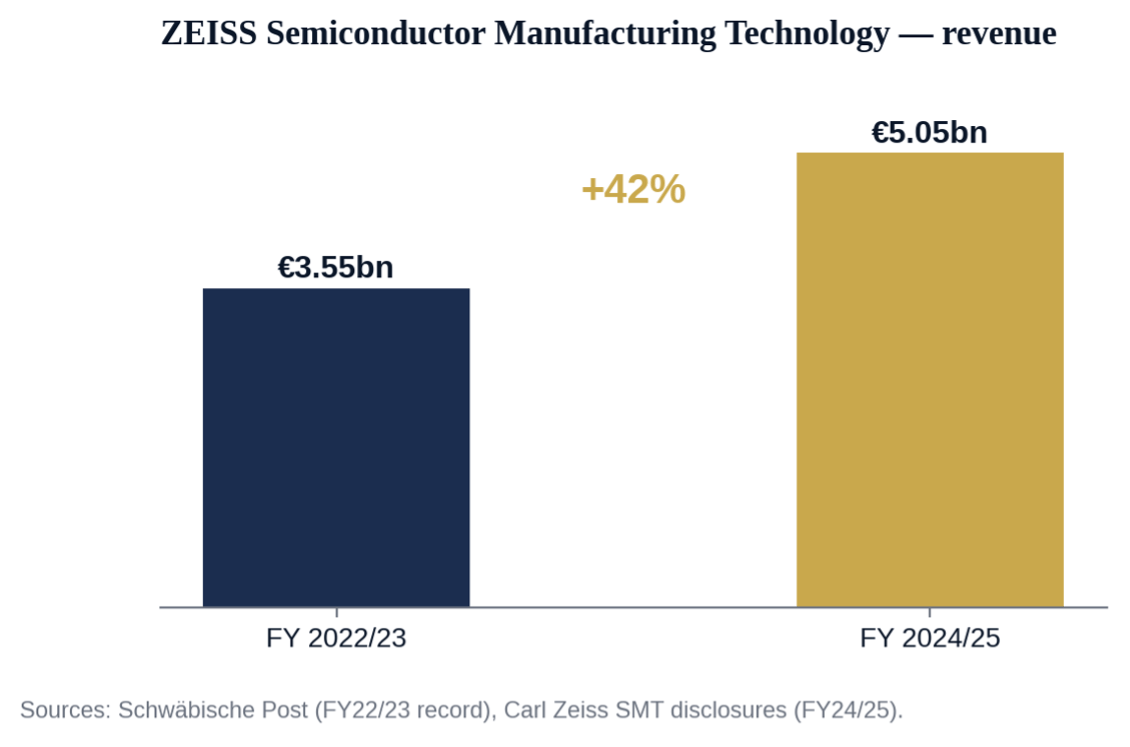
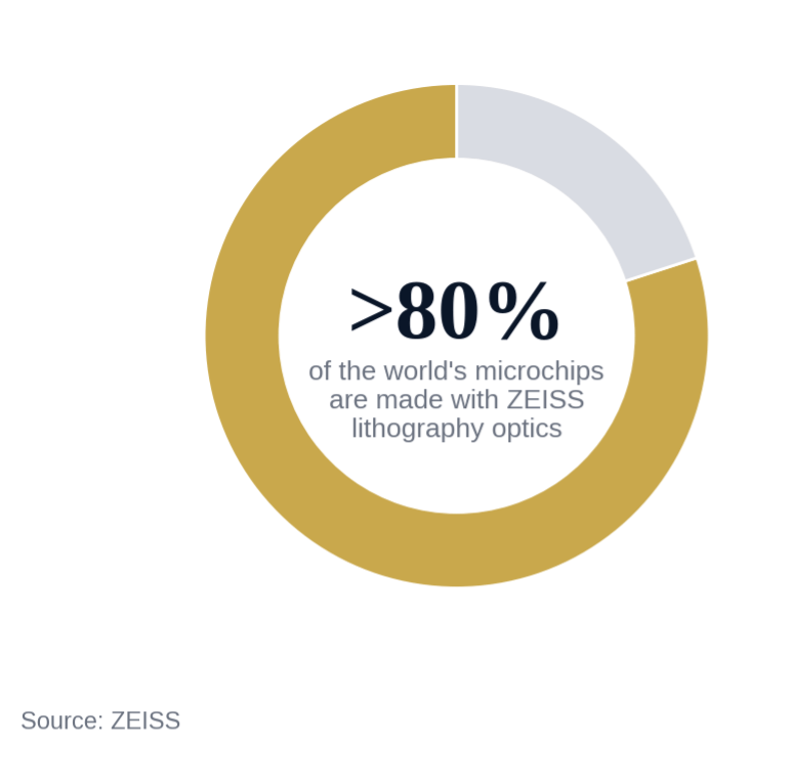
More than 80% of the world's microchips are manufactured using lithography optics from ZEISS in Oberkochen. The group's semiconductor division, ZEISS SMT, generated €5.06 billion in revenue in FY 2024/25 — up roughly 42% from its FY 2022/23 record — and ASML, itself a monopoly, holds a 24.9% stake in the unit because its EUV machines are physically impossible without ZEISS mirrors, among the most precise objects ever manufactured. The next generation, High-NA EUV, absorbed an estimated ten million ZEISS engineering hours and is entering serial chip production.
The light inside those machines comes from Trumpf, the family-owned laser group from Ditzingen — German business media recently framed the dependency bluntly: this laser decides the future of Nvidia and Apple. And on the component level, Infineon has now been the world's No. 1 automotive semiconductor supplier for six consecutive years (TechInsights, 2025 study), is global leader in automotive microcontrollers and a long-standing leader in power semiconductors — while expanding into quantum and space applications. BMW's Neue Klasse alone integrates more than 200 Infineon products, with smart eFuses replacing up to 150 conventional fuses per vehicle and improving energy efficiency by around 20%.
Section 2
Robotics & Physical AI: the data moat on the factory floor
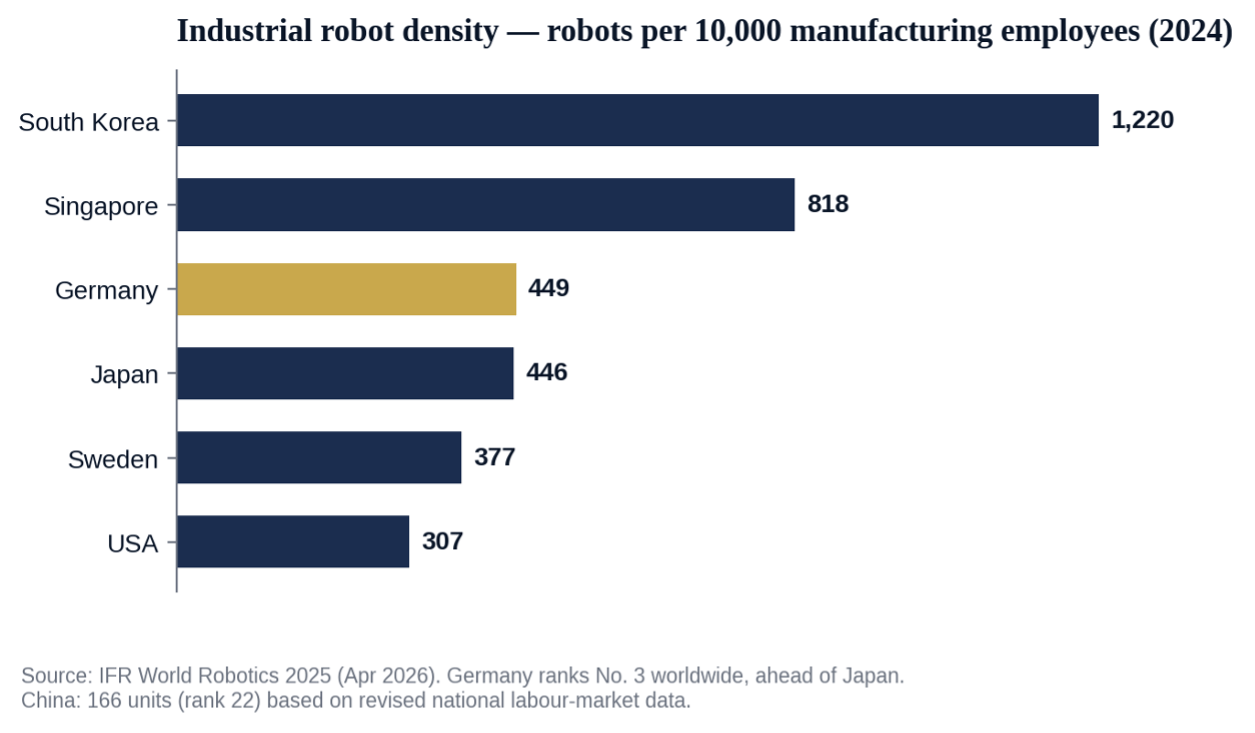
Software AI is constrained by compute; Physical AI is constrained by real-world training data from live production environments — and no region owns more of it than Germany. According to the IFR's World Robotics 2025 report, Germany ranks third worldwide with 449 industrial robots per 10,000 manufacturing employees — ahead of Japan and far ahead of the United States — while Western Europe leads the regional race with a record 267 units against North America's 204 and Asia's 131. Based on revised national labour data, China stands at 166 units (rank 22), even as it operates the world's largest absolute robot stock.
In January 2026, Bosch and Neura Robotics — Europe's humanoid-robotics pioneer from Metzingen, with a reported order book above €1 billion — announced a strategic technology and development partnership; Bosch simultaneously founded Robert Bosch Robotics GmbH. Workers in Bosch's roughly 300 plants wear sensor suits capturing real movement, work and environmental data: precisely the physical training data that, in the words of Neura CEO David Reger, nobody in the industry has at scale. On 10 June 2026, the capital markets validated the thesis: Neura closed a Series C of up to $1.4 billion — described as the largest financing ever for a full-stack robotics company — with Tether, Amazon, Nvidia, Qualcomm, Bosch, Schaeffler and the European Investment Bank among the investors, at a reported valuation of around €7 billion and a plan to scale production to millions of robots by 2030. Schaeffler, which agreed its own Neura cooperation in late 2025, told investors in January 2026 that humanoid robotics is becoming a strategic growth option with low capital intensity.
For allocators, the sharper question is where value accrues. Germany's strongest position is not consumer humanoids but the industrial stack behind automation: precision components, sensors and actuators, machine control, factory integration, safety systems, industrial software, production data and lifecycle services. A robot in a factory is not an AI model with arms — it must run safely, continuously and economically inside a real operating environment, which demands data, domain knowledge, certification, reliability and years of operational learning that cannot be downloaded. KUKA, with more than 550,000 robots installed worldwide and a top-two global position, has named the shift directly: from deterministic “Automation 1.0” to AI-first, intent-based “Automation 2.0,” anchored by its KUKA AMP software platform unveiled alongside Nvidia. The orchestration moves into software while the hard-won physical base stays in German hands — an ecosystem no rival region can assemble. The adoption signal reaches the largest manufacturers: BMW is piloting humanoid robots in its production network, validating the industrial use case at scale.
The infrastructure layer is moving in parallel. At Audi's Böllinger Höfe plant, Siemens deployed the world's first fully virtualised, TÜV-certified machine control (Simatic S7-1500V): body-shop robots welding the e-tron GT are controlled from a secure local cloud, with rollout planned across Audi's plants — factory reconfiguration becomes a software update. Diffusion runs deep: in spring 2026 a district hospital in Erding, Bavaria, reported a world-first robot-assisted adrenal-gland removal. When frontier robotics reaches a regional Klinikum, a technology has stopped being a pilot and started being an economy.
Section 3
AI, software & defence: the record-breakers
June 2026 delivered the proof point: Neura Robotics closed its Series C of up to $1.4 billion — a record for the robotics industry — while Munich-based defence-AI company Helsing is reportedly in advanced negotiations for a round of about $1.2 billion at an $18 billion valuation, led by US investor Dragoneer alongside Lightspeed, which would make Helsing Germany's most valuable startup. Berlin's workflow-automation company n8n reached a $5.2 billion valuation in May 2026 following an investment by SAP — a doubling in under a year — with its tooling to be embedded natively in SAP's Business AI platform.
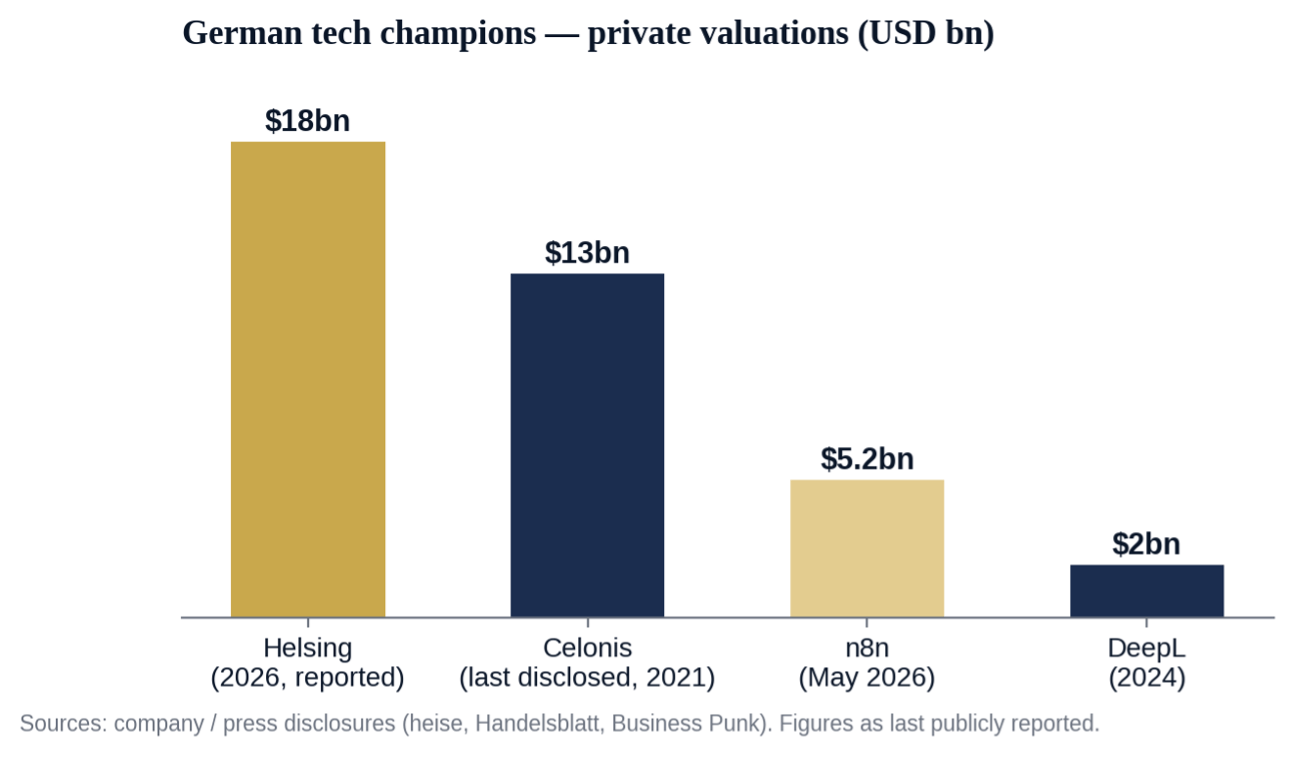
Beneath the headlines sits a software layer most allocators underestimate: SAP anchoring European enterprise AI, Celonis in process mining, DeepL in language AI, Aleph Alpha in sovereign models. Rising European defence budgets give this layer something European consumer tech never had: revenue visibility backed by state demand. The bench runs deeper than Helsing: HENSOLDT in sensors, Diehl Defence and Rohde & Schwarz in the MQ-28 collaborative-combat-aircraft industry team, and a wave of AI-enabled systems such as counter-drone weapon stations now signal a broad-based German defence-tech base.
Section 4
Sovereign cloud: regulation becomes a revenue line
At SAP's Sapphire conference in Madrid in May 2026, the partnership with France's Mistral AI was presented as a centrepiece, with data confidentiality as the explicit selling point. SAP and Deutsche Telekom won the German federal tender for a sovereign AI platform (“Germany Stack”); a consortium around Schwarz Digits won a parallel award. SAP's Sovereign Cloud president has put the company's investment in sovereign infrastructure at €20 billion.
Schwarz Digits — the IT arm of Europe's largest retail group — is methodically becoming a European hyperscaler. In May 2026 it announced with KPN a sovereign cloud for the Netherlands, hosted in Dutch data centres on its STACKIT platform, audited against Germany's BSI C5 security standard and explicitly positioned as an independent alternative for government, finance, energy and healthcare; the Dutch region is expected live in mid-2027. The europeanisation now reaches the productivity layer itself: trade press reports an emerging European office suite (“Office EU”) positioned as a sovereign alternative to Microsoft 365 and Google Workspace. The sovereignty logic now extends into defence: in 2026 Schwarz Digits founded a dedicated Schwarz Digits Defence unit — led by a former Airbus Defence digital-and-cyber executive — and signed a strategic partnership with sensor house HENSOLDT for “software-defined defence,” delivering sovereign cloud and AI-driven sensor fusion from the central data centre to the tactical edge. The same German group building Europe's commercial hyperscaler is now building its military one. For the first time, European regulation — data residency, NIS2, sovereign procurement — creates protected demand for European providers rather than merely taxing innovation.
Section 5
Energy, grid & efficiency: AI's binding constraint is German engineering
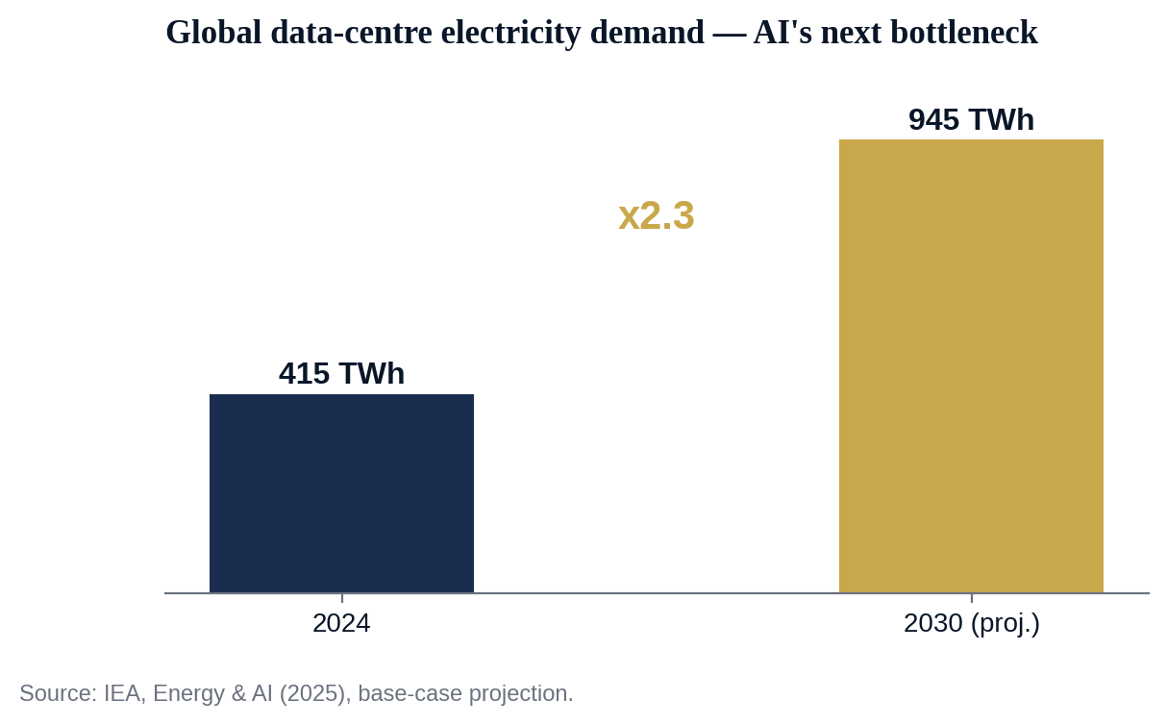
AI's bottleneck is shifting from chips to electricity. The IEA projects global data-centre power demand to more than double from roughly 415 TWh in 2024 to around 945 TWh by 2030. The equipment that build-out requires — turbines, transformers, high-voltage grid technology — is exactly where German engineering dominates, and the order books prove it.
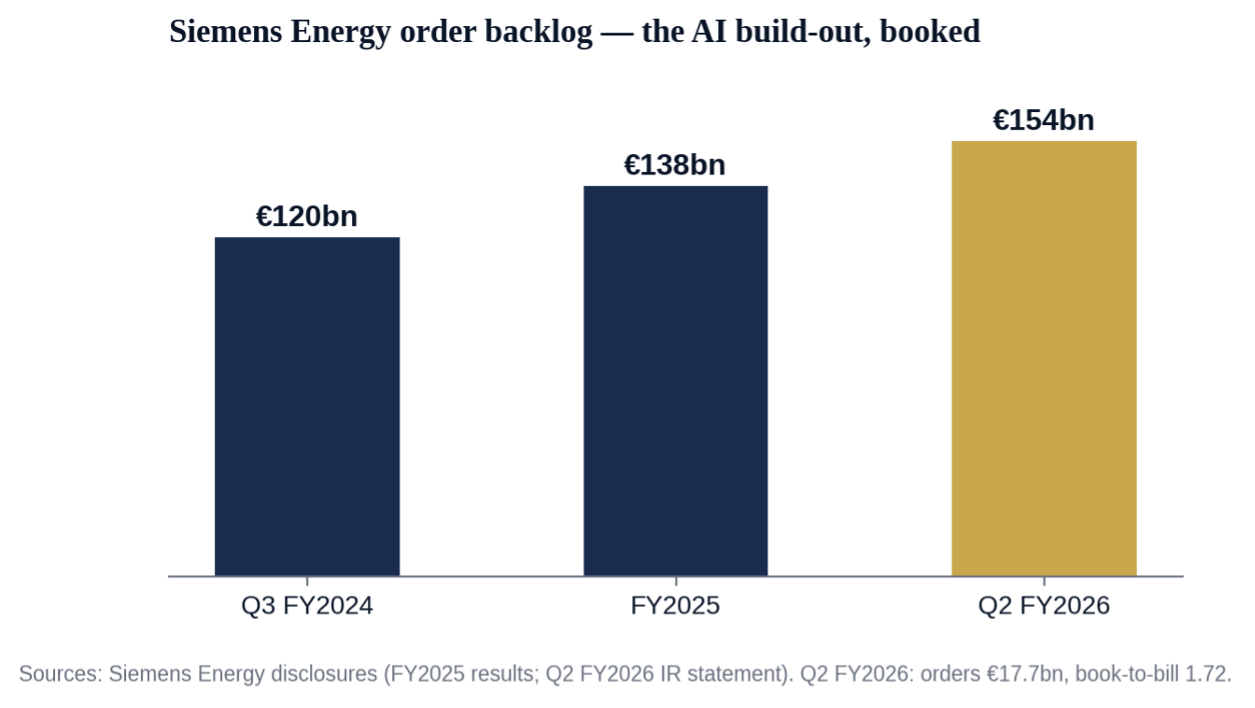
Siemens Energy booked five gigawatts of data-centre orders in the second quarter of FY 2026 alone; data centres now account for roughly a quarter of its Gas Services order intake, and its CEO has publicly noted that US AI hyperscalers depend on German industrial equipment for their expansion. Grid investment compounds the theme: Dutch-German grid operator TenneT alone plans average annual investments of around €13 billion between 2026 and 2030.
Efficiency and electrification close the loop — and the intellectual property is German to its roots. Rainer Marquardt, the German engineer honoured with the European Inventor Award, created the modular multilevel converter — the power-electronics architecture that, as ingenieur.de put it, sits in nearly every modern power grid and underpins today's HVDC transmission links. Infineon's power semiconductors sit at the heart of energy conversion in data centres, solar inverters and electric vehicles. In drivetrain engineering, Mercedes-Benz began series production of axial-flux motors — dubbed the “V8 of the electric age” — at its Berlin-Marienfelde plant in June 2026, an efficiency-and-power-density technology many competitors failed to industrialise. And industry reporting in 2026 concluded that Mercedes-Benz and BMW have closed the technology gap to Tesla and the Chinese leaders, with 800-volt architectures, advanced battery management and software-defined energy systems built on German components. The efficiency push reaches heavy industry too: German producers are moving to hydrogen-based stainless-steel manufacturing, cutting the carbon and energy intensity of one of the economy's hardest-to-abate sectors.
Section 6
Engineering, services & parts: the ecosystem behind the champions
Behind each flagship stands what Handelsblatt recently called an “unusually broadly positioned” Mittelstand: thousands of specialised suppliers of precision parts, optics, sensors, drives and industrial services. Research by Hermann Simon has long attributed to Germany the world's largest population of “hidden champions” — niche global market leaders, by his count well over a thousand. The ecosystem is also resilient: after the high-profile insolvency of air-taxi pioneer Lilium, Bavarian eVTOL company ERC is being positioned as the region's next answer in advanced air mobility. The German Innovation Award 2026 and a continuing stream of world-first deployments — from cloud-controlled production lines to a German neural implant programme aiming to change medicine — signal that the innovation engine extends far beyond the listed names. For private capital, this layer is the practical entry point: succession situations, carve-outs and growth rounds in companies whose products the global AI build-out cannot do without.
Section 7
Investor implications: how to position before the re-rating completes
- Own the chokepoints and the stack, not the narrative. The deepest moats in AI are physical — optics, lasers, power semiconductors, grid equipment — plus the industrial layer behind automation: components, control, integration, safety, production data and lifecycle services. Built over decades, this is far harder to replicate than any model, and much of it trades at industrial multiples or sits in private and family ownership.
- Buy the data moat early. Physical AI is the rare frontier where Europe leads on the scarce input. Access runs through minority growth investments and co-investments alongside industrial anchors such as Bosch and Schaeffler — while cap tables remain open.
- Treat sovereignty as protected demand. Sovereign cloud, defence AI and federal platform contracts give European tech state-anchored revenue visibility for the first time, at valuations well below US comparables. Allocate to the providers regulation now favours.
- For family offices, AI is an operating capability — not only an allocation. As owners of operating companies, real estate and industrial holdings, family offices should ask where AI creates measurable portfolio value: automated reporting and forecasting, investment screening, productivity tools for portfolio companies, cybersecurity and NIS2 readiness, sovereign cloud architecture, process mining, document automation and risk monitoring. Europe's trusted-AI stack is built for exactly these regulated use cases.
- Use the Mittelstand as the entry point. Succession, carve-out, supplier-platform and growth situations across the ecosystem let disciplined private capital acquire irreplaceable technology at conservative valuations.
- Gulf capital fits this moment unusually well. Sovereign-minded, long-duration and industrially strategic, GCC family offices and institutions diversifying beyond US tech find in DACH frontier technology, conservative pricing and aligned governments — while the Gulf's own automation, logistics, manufacturing-localisation, healthcare, energy and smart-city programmes create demand German engineering is built to serve. That two-way bridge is the core of the Akroporos thesis.
Discuss this report with us
Akroporos Partners shares tailored analyses and qualified deal flow across the German technology stack with investors and family offices upon request. Follow Akroporos Partners on LinkedIn or contact us via our website to receive the underlying three-part series and sector deep-dives.
About Akroporos Partners
Akroporos Partners is a Munich-based advisory boutique serving family offices, investors and entrepreneurs across three pillars: Family Office & Private Equity Advisory, M&A and Corporate Finance, and a dedicated Germany–Gulf capital bridge. We combine senior international experience with deep access to Germany's industrial technology landscape — from listed champions to Mittelstand succession and growth situations.
Sources & methodology
- ZEISS SMT corporate disclosures (FY 2024/25 revenue; >80% market position; High-NA EUV); Schwäbische Post (FY 2022/23 record).
- Welt, 2026 (Trumpf EUV laser and Nvidia/Apple dependency).
- TechInsights via Infineon / trade press, 2025–2026 (automotive semiconductor leadership, 6th consecutive year; BMW Neue Klasse content).
- IFR World Robotics 2025, press release 8 April 2026 (robot density 2024; regional comparison; revised China data).
- Neura Robotics press release, 10 June 2026 (Series C of up to $1.4bn, milestone-linked; investor consortium incl. Tether, Amazon, Nvidia, Qualcomm, Bosch, Schaeffler, EIB); press reports on ~€7bn valuation.
- Handelsblatt, 15 January 2026 (Bosch–Neura cooperation); Neura Robotics press release, 14 January 2026; stock3 (Schaeffler Pre-Close Call, 30 January 2026); KUKA Group / NVIDIA GTC coverage, March–April 2026 (“Automation 2.0,” KUKA AMP; 550,000+ robots installed).
- Handelsblatt, August 2025 (Siemens–Audi world-first virtual machine control); Merkur, 2026 (Klinikum Erding).
- Handelsblatt via Business Punk, May 2026 (Helsing — reported negotiations, not closed); heise/iX, May 2026 (SAP–n8n, $5.2bn).
- Stimme.de, May 2026 (SAP Sapphire Madrid: Mistral partnership, federal sovereign AI platform awards); press reporting on SAP's €20bn sovereign-cloud commitment.
- KPN press release, 28 May 2026 (KPN × Schwarz Digits / STACKIT sovereign cloud, Netherlands).
- Siemens Energy disclosures, FY2025 and Q2 FY2026 (order backlog, data-centre orders); IEA, Energy & AI, 2025; press reporting on TenneT investment plans.
- Handelsblatt, 2026 (Mittelstand breadth; Mercedes-Benz/BMW EV technology catch-up); Hermann Simon, hidden-champions research; German Innovation Award 2026 coverage.
- ingenieur.de, 10 June 2026 (Mercedes-Benz axial-flux motor series production, Berlin-Marienfelde); ingenieur.de, 2026 (European Inventor Award for Rainer Marquardt — modular multilevel converter).
- GameStar trade press, 2026 (“Office EU” sovereign office suite); Focus, 2026 (ERC, Bavarian eVTOL after Lilium insolvency).
- hartpunkt / Stimme.de / HENSOLDT, February–June 2026 (Schwarz Digits Defence unit; HENSOLDT “software-defined defence” partnership, MDOcore).
- MDR, 2026 (BMW humanoid-robot piloting); suv.report / defence-network, 2026 (Diehl Defence & Rohde & Schwarz MQ-28 team; AI counter-drone weapon station).
- golem.de, June 2026 (hydrogen-based stainless-steel production).
- Atlantic Council 2026 Prosperity Index and 2026 Global Human Prosperity Index (Europe's leading placement; Germany in the elite tier); Visual Capitalist coverage.
Disclaimer: This document is general market commentary prepared for information purposes only. It does not constitute investment advice, a recommendation, an offer or a solicitation to buy or sell any security or to engage in any transaction. Figures marked as “reported” reflect press coverage of transactions that may not have closed. Akroporos Partners accepts no liability for decisions made on the basis of this document. © 2026 Akroporos Partners, Munich. All rights reserved.
Where intelligence opens doors.